A practical way to uncover expenses worth checking before you file—without guessing which “write-offs” apply to you
You reach the end of your tax return.
The income is entered. The forms are nearly finished. The numbers are staring back at you.
But one question remains:
Did you overlook an expense that could matter?
Maybe you have receipts tucked away in folders.
Maybe your bank and credit-card statements contain expenses you barely remember.
Maybe you paid for work-related items, education, health expenses, charitable contributions, home-related costs, or other things during the year—and you're not sure whether any of them deserve a closer look.
You don't want to leave a legitimate deduction unexplored.
But you don't want to claim questionable expenses either.
And that's where tax-time uncertainty begins.
The Problem Isn't Always What You Spent
You already know you spent money.
The harder question is knowing which expenses deserve tax attention.
That's surprisingly easy to get wrong.
A transaction might look completely ordinary until you understand why the money was spent.
Another might sound obviously tax-related but turn out to require facts you haven't considered.
And the label on a receipt rarely gives you the complete answer.
“Education.”
“Medical.”
“Office.”
“Donation.”
“Home expense.”
Those words may point you toward something worth investigating.
But they don't automatically establish a deduction.
That leaves many taxpayers caught between two bad approaches.
One is to ignore anything that doesn't obviously look deductible.
The other is to search for every possible “write-off” and hope something fits.
Neither gives you a reliable way to review the expenses you actually paid.
Why Giant Deduction Lists Can Leave You More Confused
Search for tax deductions and you'll find plenty of possibilities.
But there's a problem with starting from a massive list:
You're beginning with somebody else's categories instead of your own records and circumstances.
You might overlook an expense because it isn't described the same way as the list you're reading.
Or you might see an expense on a generic “tax write-off” list and assume it applies to you without checking the requirements.
That's how the same research can create opposite mistakes.
You can overlook something legitimate...
...or become too confident about something that doesn't apply.
There's a better question to ask:
“Which expenses I already paid deserve a closer look?”
That simple shift changes the entire review.
Instead of trying to become a tax expert overnight, you begin with the expenses already sitting in your receipts, invoices, statements, and records.
Then you filter them.
Introducing Hidden Tax Savings
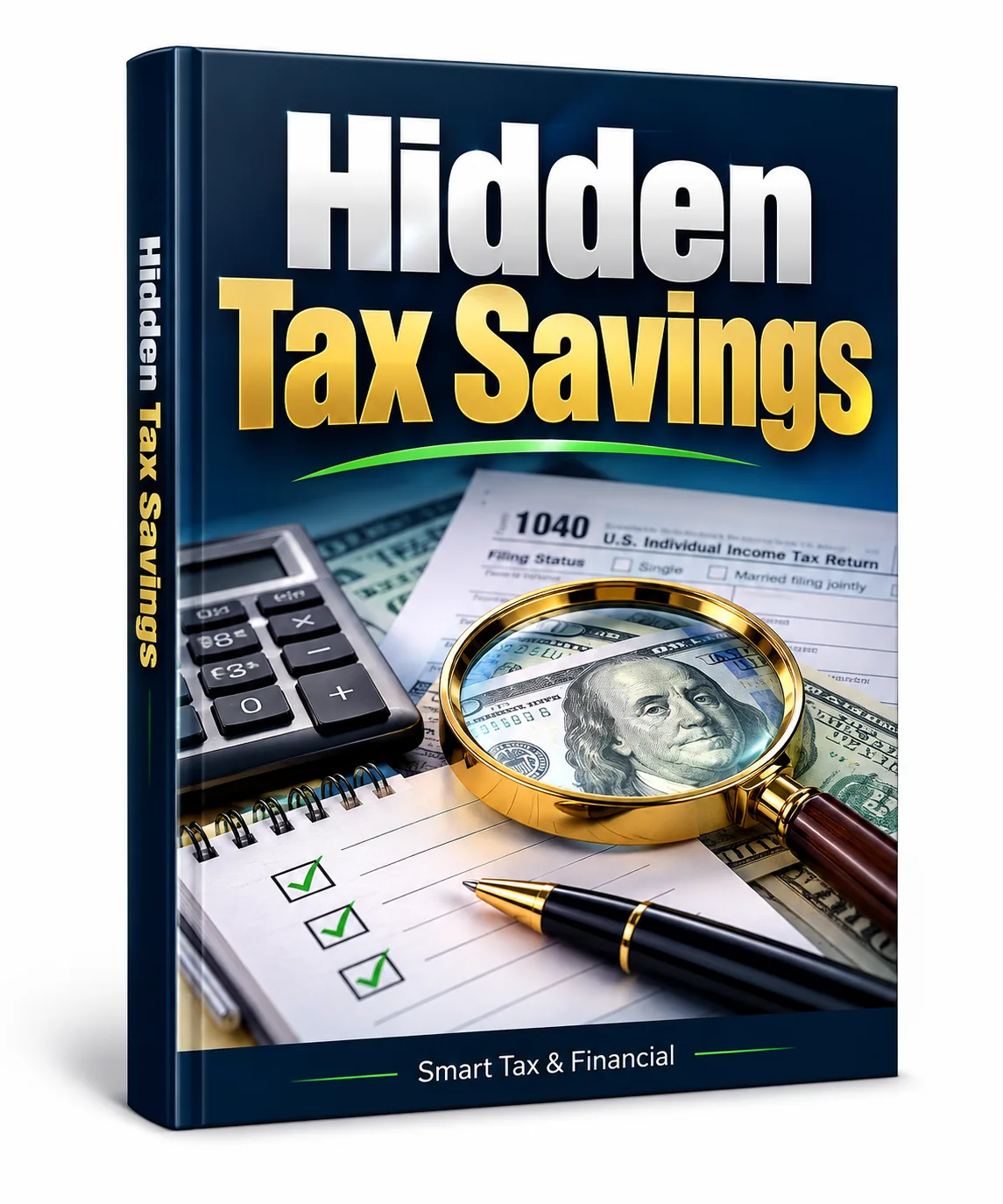
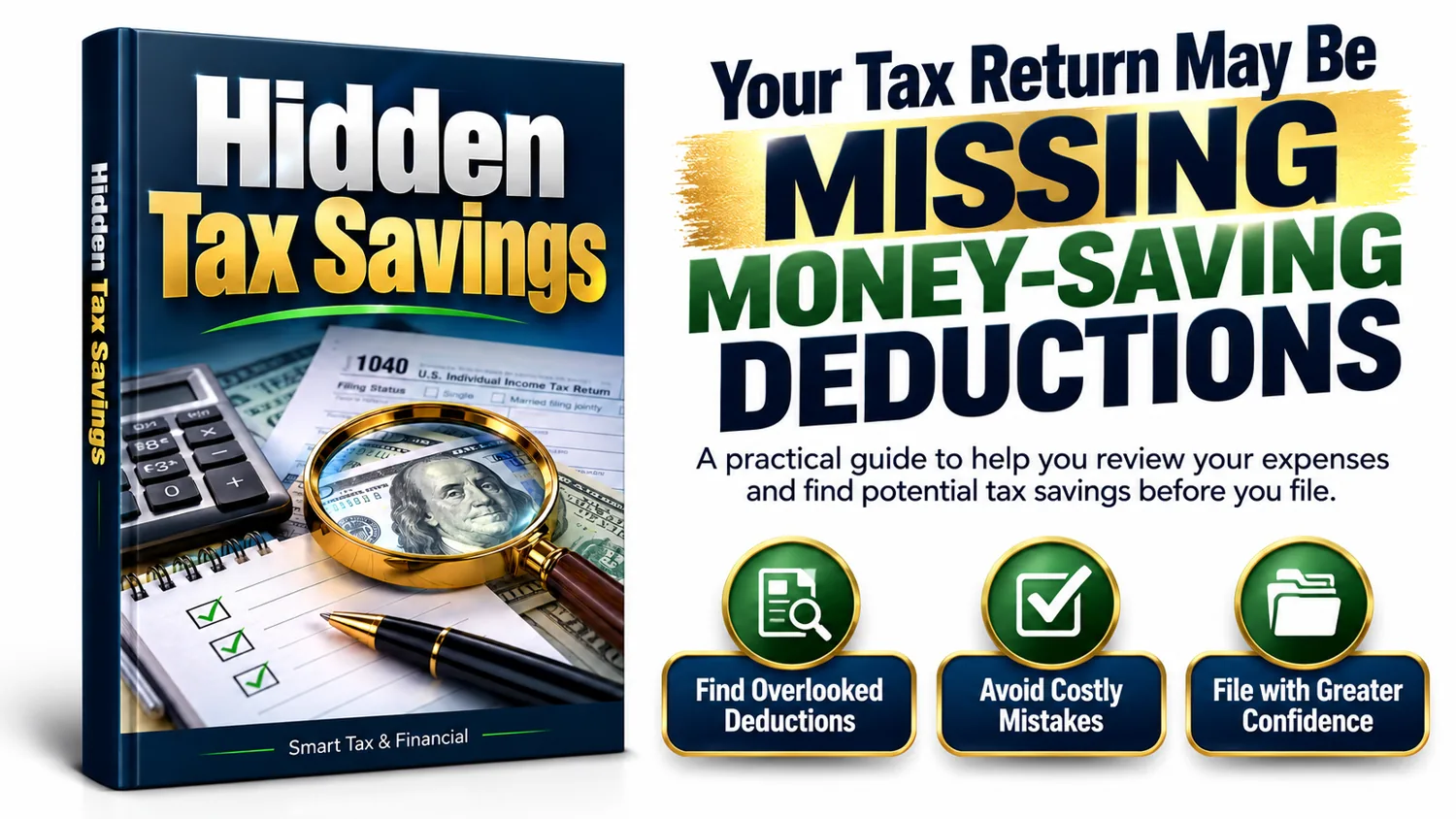
Hidden Tax Savings, from Smart Tax & Financial, is a focused informational report designed to help everyday US taxpayers review familiar expenses before finalizing a federal tax return.
It doesn't encourage you to hunt for aggressive tax loopholes.
It doesn't tell you that every work, home, medical, education, or charitable expense is deductible.
And it doesn't bury you under a giant encyclopedia of tax rules.
Instead, it teaches you a practical way to identify expenses that deserve further attention—while separating them from expenses that usually don't and expenses that can't be evaluated until you know more.
The result?
A focused shortlist of expenses worth checking before you file.
Meet the Tax Deduction Filter
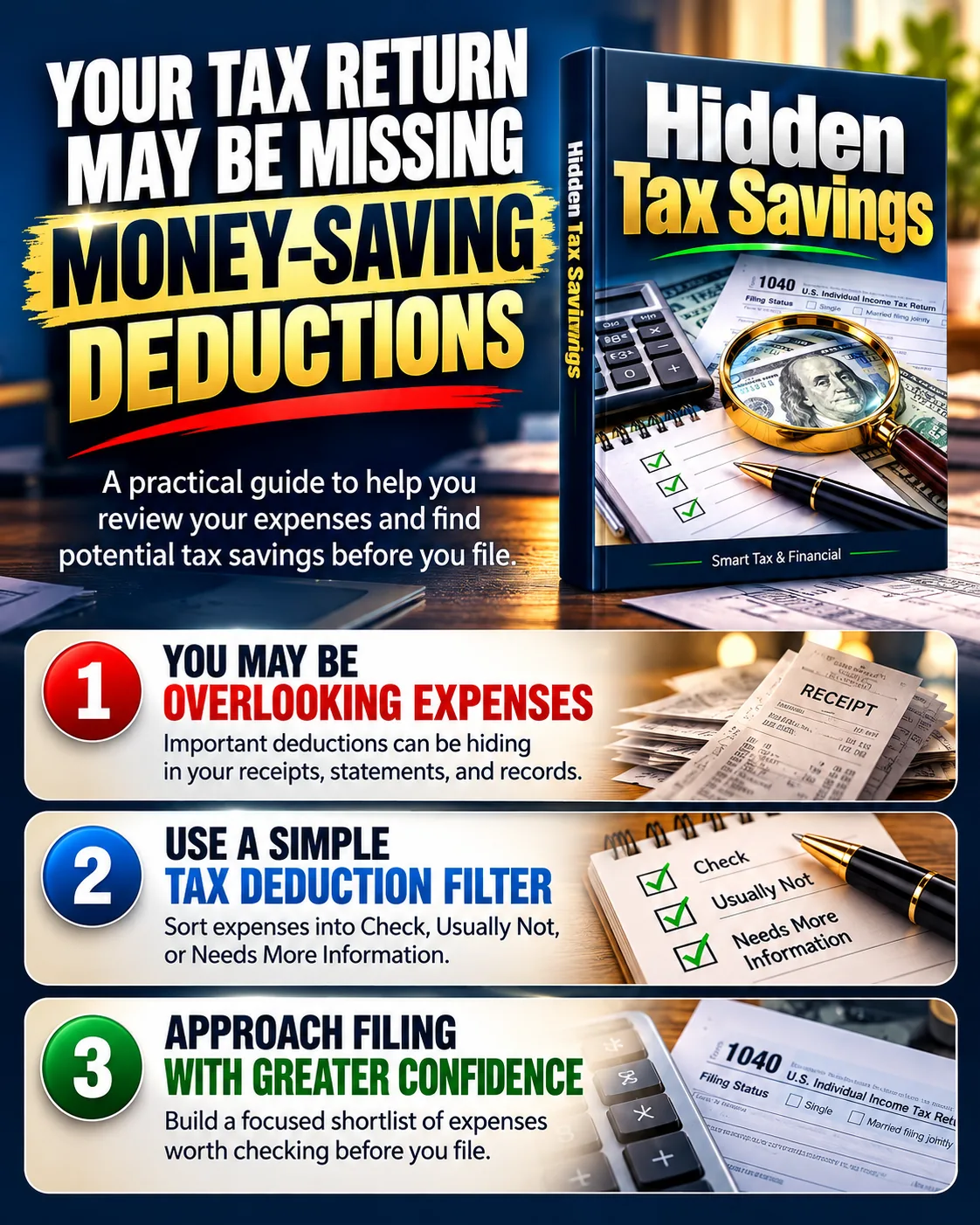
At the center of Hidden Tax Savings is a simple three-way Tax Deduction Filter.
Instead of forcing every expense into an immediate “deductible” or “not deductible” decision, you sort it into one of three practical categories:
CHECK
There's a concrete reason this expense may deserve further tax review.
You're not declaring it deductible.
You're recognizing that dismissing it without checking could be premature.
USUALLY NOT
Based on the circumstances you're reviewing, there's no meaningful reason to spend more time treating the expense as a potential deduction.
This helps prevent ordinary personal spending from cluttering your review.
NEEDS MORE INFORMATION
Something important is missing.
Maybe you don't know exactly what the payment covered.
Maybe the expense had both personal and potentially qualifying use.
Maybe reimbursement is unclear.
Maybe you need better documentation.
Or perhaps you need to verify which tax rule actually applies.
Instead of guessing, you identify the uncertainty.
That third category can be particularly valuable because tax questions aren't always ready for a yes-or-no answer.
You Don't Need More Guesswork. You Need Better Questions.
One of the biggest shifts you'll make with Hidden Tax Savings is learning to stop asking only:
“Can I deduct this?”
You'll start asking questions such as:
What was this expense actually for?
Why was it incurred?
Who paid it?
How was it used?
Was any part personal?
Was I reimbursed?
What documentation do I have?
What current tax rule am I actually trying to apply?
Those questions help expose the difference between an expense that merely sounds deductible and one that genuinely deserves investigation.
And that difference can save you from wasting time on weak possibilities while helping you notice expenses you might otherwise dismiss too quickly.
What You'll Be Able to Do Differently
After reading Hidden Tax Savings, you'll have a clearer way to approach your records before filing.
You'll understand how to:
Spot overlooked expenses worth investigating instead of relying entirely on memory or generic deduction lists.
Separate possible deductions from ordinary personal spending so your review stays focused on expenses with a genuine reason for attention.
Recognize when “I use it for work” isn't enough and identify the additional facts that may affect tax treatment.
Handle mixed-use expenses more carefully instead of assuming that some potentially qualifying use automatically makes the entire cost deductible.
Look beyond the merchant name on a statement and focus on the purpose, circumstances, and actual use of an expense.
Identify documentation gaps before filing rather than discovering too late that a bank transaction doesn't explain what was purchased or why.
Catch reimbursements, refunds, and duplicate records that can make an expense look different when viewed in isolation.
Distinguish a possible deduction from a possible credit so you don't discard an expense simply because the tax benefit isn't the one you originally expected.
Recognize when current tax rules need verification instead of relying on an old article, social-media post, or oversimplified “write-off” tip.
Know when an expense has become too fact-specific for a simple filter and should be taken to a qualified tax professional.
Build a smaller, better-supported shortlist instead of measuring success by how many deductions you can collect.
Move from expense to decision in a logical order: identify, classify, document, verify, then decide.
The Details That Change the Answer
Two people can spend exactly the same amount on exactly the same type of item and still face different tax questions.
Why?
Because tax treatment isn't determined by the price tag alone.
Consider two people who each purchase the same kind of equipment.
One uses it entirely for ordinary personal purposes.
The other uses similar equipment in circumstances connected with an income-producing activity.
The object may be identical.
The price may be identical.
The receipt may look nearly identical.
The facts aren't.
Now add another possibility: the item is used partly personally and partly for an activity with potential tax relevance.
Suddenly, “Is this deductible?” isn't even the most useful first question.
You need to understand the use, circumstances, applicable rules, and documentation before reaching a responsible conclusion.
Hidden Tax Savings teaches you to notice those distinctions.
A Receipt Isn't the Same as a Deduction
Having documentation matters.
But having a receipt doesn't automatically establish tax treatment.
Suppose your bank statement shows a $900 payment.
You know the money left your account.
But what did you purchase?
Why did you purchase it?
Was it later reimbursed?
Was the expense personal, potentially qualifying, or mixed?
A bank transaction may prove that a payment occurred without answering any of those questions.
An invoice may reveal more.
A detailed receipt may reveal more.
Other records may explain the purpose or circumstances.
This is why the report teaches you to think about documentation as part of the decision—not as paperwork you worry about only after deciding you want a deduction.
One Expense Can Appear in Several Places
Here's another detail that's easy to miss.
You might have:
A paper receipt.
An emailed invoice.
A credit-card transaction.
A bank payment.
A bookkeeping entry.
That isn't five expenses.
It's potentially five records connected with one expense.
Review those sources independently and the same transaction can accidentally appear more than once on your shortlist.
Hidden Tax Savings shows you why the filter should follow the underlying expense—not the number of documents associated with it.
That's the kind of small distinction that makes a pre-filing review more reliable.
What About Work Expenses?
Work-related spending is one of the easiest areas in which to jump to conclusions.
You paid for something yourself.
You needed it to do your work.
Nobody reimbursed you.
So it feels natural to think:
“It was for work, so it must be deductible.”
But your work status and circumstances can change the tax question.
An employee paying an unreimbursed job expense isn't automatically in the same tax position as someone paying an expense associated with a separate qualifying business activity.
Hidden Tax Savings helps you move beyond “Was this for work?” and ask the more useful question:
“In what capacity did I incur this expense, and what rules apply to that situation?”
Home, Education, Health and Charitable Expenses Need the Same Discipline
Working from home doesn't automatically turn household bills into deductions.
Paying tuition doesn't tell you by itself which tax benefit, if any, may apply.
A medical-looking transaction doesn't automatically tell you its tax treatment.
And calling a payment a “donation” doesn't establish that it meets the requirements for a charitable deduction.
These categories are worth attention precisely because they can look straightforward.
Hidden Tax Savings helps you identify the details that need to be checked before a familiar label becomes a filing decision.
Designed for a Focused Pre-Filing Review
This isn't intended to turn you into a tax professional.
And you don't need to memorize a massive body of tax law to use the core approach.
You start with what you already have.
Your expenses.
Your receipts.
Your statements.
Your invoices.
Your records.
Then you use a simple filter to determine what deserves attention.
For uncertain items, you identify the missing fact instead of guessing.
For promising items, you verify the relevant requirements.
For ordinary expenses without a meaningful tax connection, you move on.
The process is intentionally focused:
Identify → Classify → Document → Verify → Decide
That gives you a repeatable path from a vague transaction to a much clearer question.
Who Is Hidden Tax Savings For?
This report is designed for US taxpayers preparing a federal tax return who have income and expenses but aren't confident they've identified every relevant deduction.
It's particularly useful if you've ever reached the end of your tax preparation and wondered:
“Am I forgetting something?”
It's also useful if you have receipts and statements but aren't sure which expenses deserve attention.
Or if you've encountered conflicting tax tips and don't know which ones are actually relevant to your circumstances.
Or if you're uncomfortable with both extremes—ignoring possible deductions and claiming expenses based on little more than a generic “write-off” list.
You don't need to know every deduction before you begin.
You need a practical way to identify what deserves checking.
Why Piece the Process Together From Random Tax Tips?
Without a focused method, researching deductions can quickly turn into a trail of disconnected searches.
You look up one expense.
That leads to another tax term.
Then another article introduces an exception.
A video says something different.
An old post makes a broad claim.
And eventually you're left with more browser tabs than answers.
The problem isn't necessarily a lack of information.
It's a lack of a decision process.
Hidden Tax Savings gives you that process.
Rather than trying to learn everything about taxes, you can concentrate on the expenses that actually exist in your records and the specific questions needed to evaluate them.
That can make the difference between hours of unfocused searching and a review built around a defined shortlist.
Don't Measure Success by the Number of “Write-Offs”
A good pre-filing review may make your shortlist smaller.
That's not a failure.
Suppose you identify several expenses that initially look promising.
Then you discover one was reimbursed.
Another is ordinary personal spending.
One appears twice because you found both the receipt and credit-card transaction.
Another needs additional documentation.
And a few still have a legitimate reason for further review.
You haven't “lost” deductions.
You've removed assumptions and concentrated your attention where it belongs.
That's the point.
The goal of Hidden Tax Savings isn't to help you claim the most.
It's to help you overlook less while claiming only what can be properly supported and verified.
Give Your Records One More Look Before You File
You don't necessarily need another enormous list of deductions.
You may need a better way to review the expenses you've already paid.
That's what Hidden Tax Savings gives you.
Use the Tax Deduction Filter to separate ordinary spending from expenses worth investigating.
Identify missing information before it turns into guessing.
Look beyond labels and focus on purpose, use, circumstances, and documentation.
Verify potentially relevant items against current requirements.
And when a question becomes too fact-specific to resolve confidently, you'll be better prepared to take a clear, focused question to a qualified tax professional.
Get Hidden Tax Savings from Smart Tax & Financial
Use it before you finalize your federal tax return to create a focused shortlist of expenses worth checking—and approach those expenses with a clearer process for deciding what deserves further verification.
YOUR NEXT STEP
Give your expenses one more focused review.
Get the report and identify what deserves checking before you file.
Get Hidden Tax SavingsBefore You File, Check What You've Already Paid
A potentially relevant expense doesn't always look important when you first see it.
And an expense that sounds tax-related isn't automatically deductible.
The advantage comes from knowing the difference.
Hidden Tax Savings gives you a practical way to make that distinction before your return is finalized.
Review what you spent. Flag what deserves attention. Verify before you claim.